
In April 2026, Testing.com surveyed 1,000 U.S. adults who visited a healthcare provider in the past 12 months to understand how AI tools are shaping diagnosis, doctor visits, and the decision to seek care.
Survey highlights:
- 30.3% of Americans say AI identified a health condition their doctor missed or dismissed
- 9 in 10 of those conditions were later confirmed by a healthcare provider
- Half of Millennials say AI has caught something their doctor missed, compared to 8.1% of Boomers
- 1 in 6 Americans have corrected their doctor with AI, and the doctor agreed
- 1 in 4 adults order their own lab tests specifically for AI to analyze
- 1 in 6 have stopped seeing a primary care doctor, replacing them with AI and urgent care
9 in 10 Say Their AI Diagnosis Was Later Confirmed by a Doctor
1 in 3 (30.3%) U.S. adults say an AI tool identified a health condition their doctor had previously missed or dismissed. Within that group, 19.5% say AI has done so multiple times and 10.8% say it has happened once.
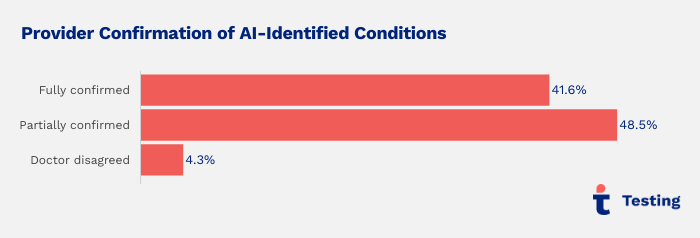
Of those who reported an AI catch, 90.1% say the condition was later confirmed by a healthcare provider, with 41.6% fully confirmed and 48.5% partially confirmed. 4.3% say their doctor disagreed with the AI’s assessment.
Respondents described three main ways AI surfaced what their doctor had missed. 36.0% said AI connected patterns across symptoms their doctor had treated as separate issues, 33.3% said AI suggested a condition based on symptoms their doctor had dismissed, and 23.1% said AI flagged abnormal trends in lab results over time.
The conditions AI most commonly caught were vitamin or mineral deficiencies (48.8%), high blood pressure or cholesterol (29.4%), mental health conditions (28.7%), skin conditions (22.4%), and hormone imbalances (21.1%).
The rate varies by generation. 50.8% of Millennials, 46.5% of Gen Z, 24.4% of Gen X, and 8.1% of Boomers and older report AI catching a condition their doctor had missed. Men are also more likely than women to report the experience, at 36.8% compared to 23.8%.
Respondents who rated their own health as excellent were the most likely to report AI catching something, at 55.8%, compared to 26.3% in good health, 23.7% in fair health, and 11.1% in poor health.
“AI can be helpful in identifying patterns or suggesting possibilities based on symptoms or data entered. It may flag issues like cholesterol concerns or prompt someone to consider screening for common deficiencies,” says Toni Brayer, M.D., an internal medicine doctor and member of Testing.com’s medical review board. “However, these are suggestions, not diagnoses. More complex conditions, such as hormone imbalances or mental health disorders, require a comprehensive, individualized evaluation. These diagnoses depend on clinical context, longitudinal history, physical exam, and careful interpretation of labs, none of which AI can fully integrate in a meaningful way at this time.”
1 in 6 Americans Have Corrected Their Doctor With AI, and the Doctor Agreed
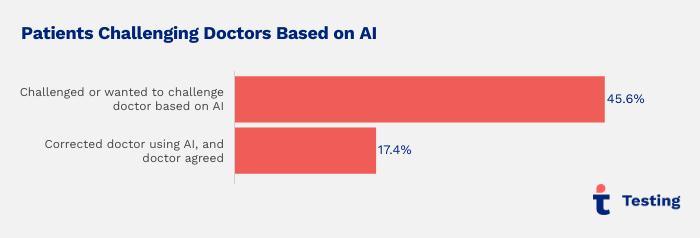
45.6% of U.S. adults say they have challenged or wanted to challenge a doctor’s diagnosis, recommendation, or dismissal based on information from AI.
17.4% say they corrected their doctor using AI and the doctor ultimately agreed with the AI’s assessment.
For adults under 35, the rate is 64.3%, compared to 40.3% of adults 35 and older.
“It is always easier for a doctor to work with an informed patient who is interested in collaborating on their health care. When patients bring in information, whether from AI or other sources, it can open the door to informed discussions and even surface issues that warrant a closer look,” says Dr. Brayer. “But AI is not the same as personalized clinical judgment. It often lacks context, may overgeneralize, and can be inaccurate. There is an important distinction between identifying a possibility and making a correct diagnosis.”
1 in 4 Americans Order Their Own Lab Tests Specifically for AI to Analyze
25.7% of U.S. adults say they order lab tests specifically for AI to analyze, with 8.6% doing so regularly and 17.1% occasionally.
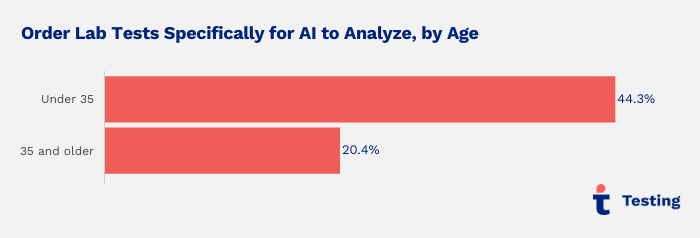
The rate among adults under 35 is 44.3%, compared to 20.4% of adults 35 and older. Among those who order labs for AI, 15.6% do so monthly or more often, 33.5% every two to three months, and 24.9% every four to six months.
80.2% of those who order their own labs for AI also say AI has caught a condition their doctor missed.
1 in 6 Americans Have Stopped Seeing a Primary Care Doctor, Replacing Them With AI and Urgent Care
16.6% of adults say they skip primary care and manage their health through AI, with 9.9% relying on AI combined with urgent care or telehealth and 6.7% saying AI guides their decisions and they only see a doctor when AI recommends it.
The rate for adults under 35 is 26.2%, compared to 13.9% of adults 35 and older.
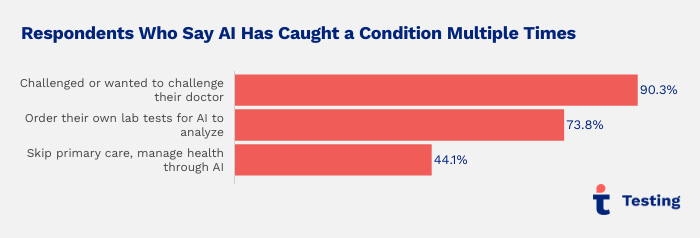
Respondents who say AI has caught a condition multiple times report higher rates across all behaviors: 44.1% skip primary care, 73.8% order their own lab tests for AI to analyze, and 90.3% have challenged or wanted to challenge their doctor based on AI.
Of those who manage their health primarily through AI, 38.0% estimate they save $500 to $1,000 per year by skipping primary care, 20.5% save $1,000 to $2,000, and 9.0% save more than $2,000.
“What concerns me is the loss of continuity. Primary care is not just about treating problems as they arise. It is about knowing the patient over time,” says Dr. Brayer. “That longitudinal relationship allows us to recognize subtle changes, track trends, and intervene early, often before a condition becomes serious or costly. There is also a false sense of savings. Skipping primary care may reduce short-term costs, but delayed diagnoses or unmanaged chronic conditions can lead to more expensive care down the line.”
Methodology
In April 2026, Testing.com surveyed 1,000 U.S. adults ages 18 and older who visited a healthcare provider in the past 12 months, using the Pollfish survey platform. Pollfish uses Random Device Engagement to reach respondents through in-app surveys rather than opt-in panels, helping reduce fraud and duplicate responses, broaden sample diversity, and improve response quality; attention checks and other fraud-detection tools were used to identify invalid responses. The margin of error is approximately ±3 percentage points at a 95% confidence level. Results are based on self-reported responses.