
Home remedy videos for sexually transmitted infections are common on TikTok and other platforms, promoting garlic, tea tree oil, and apple cider vinegar as cures. New Testing.com data shows how many young adults are trying them instead of, or before, seeing a doctor. In June 2026, Testing.com surveyed 1,000 U.S. Gen Z adults, ages 18 to 29, who have had or suspected they had an STD or STI, to learn how they responded, where they found guidance, and whether they sought care.
Survey highlights:
- 3 in 4 got their remedy from social media
- More than half found it on TikTok
- 1 in 4 were certain a home remedy would cure their STD
- 3 in 5 were too embarrassed to see a doctor first
- Half were sure their remedy had cleared the infection
3 in 4 Found Their Home Remedy on Social Media
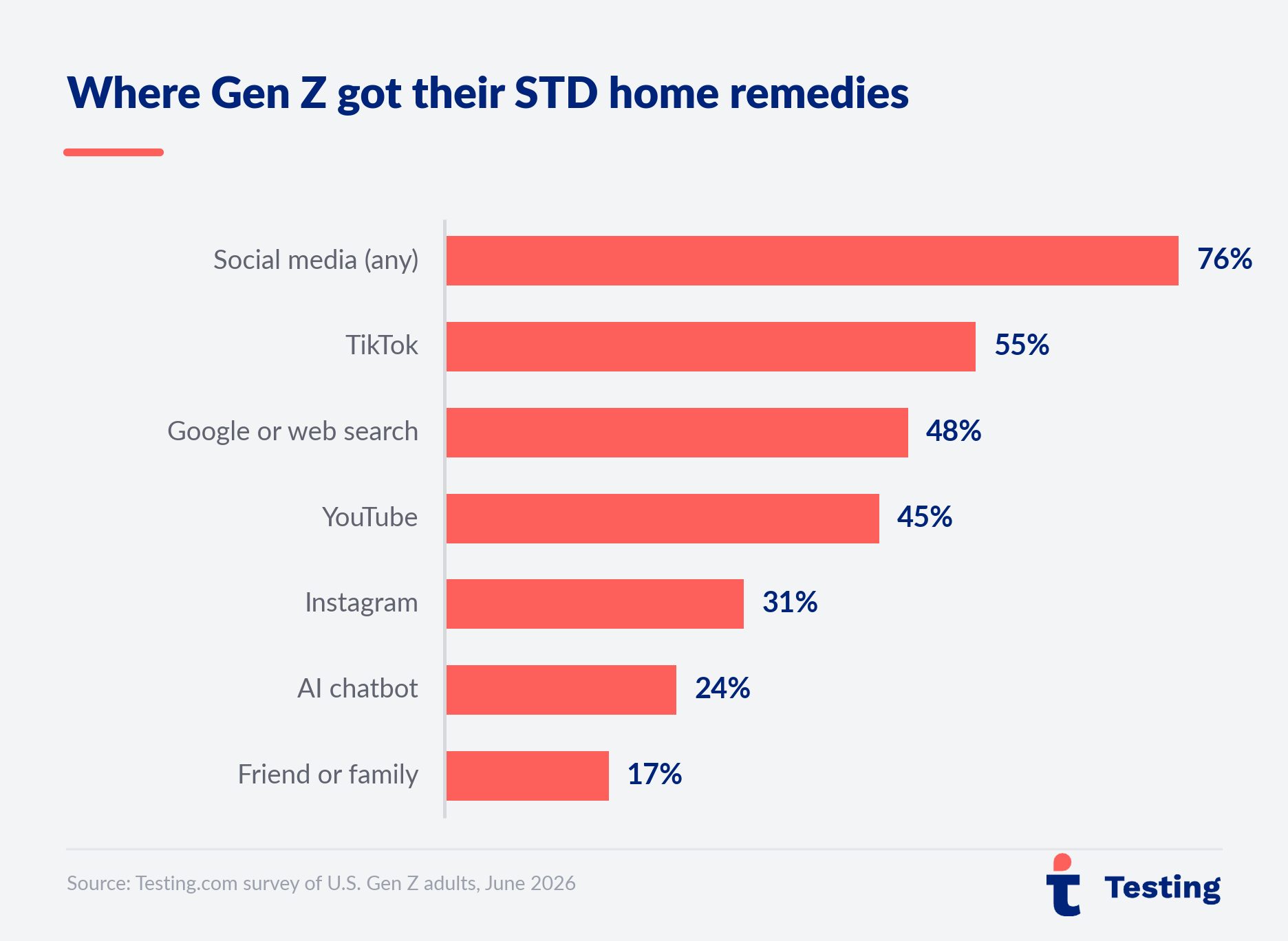
Among Gen Zers who had or suspected an STD, 41% treated it themselves with a home or natural remedy instead of seeing a doctor first. For most, the remedy came straight from their feeds. 76% of self-treaters first learned about it on a social platform, and TikTok led at 55%, followed by YouTube at 45% and Instagram at 31%.
Other digital sources fed the same behavior. 48% turned to a Google or web search and 24% got the remedy from an AI chatbot, with one respondent saying they “looked online using ChatGPT.” A friend or family member was the source for 17%, making personal contacts the least common starting point of all.
7 in 10 Used Garlic, Tea Tree Oil, or Vinegar
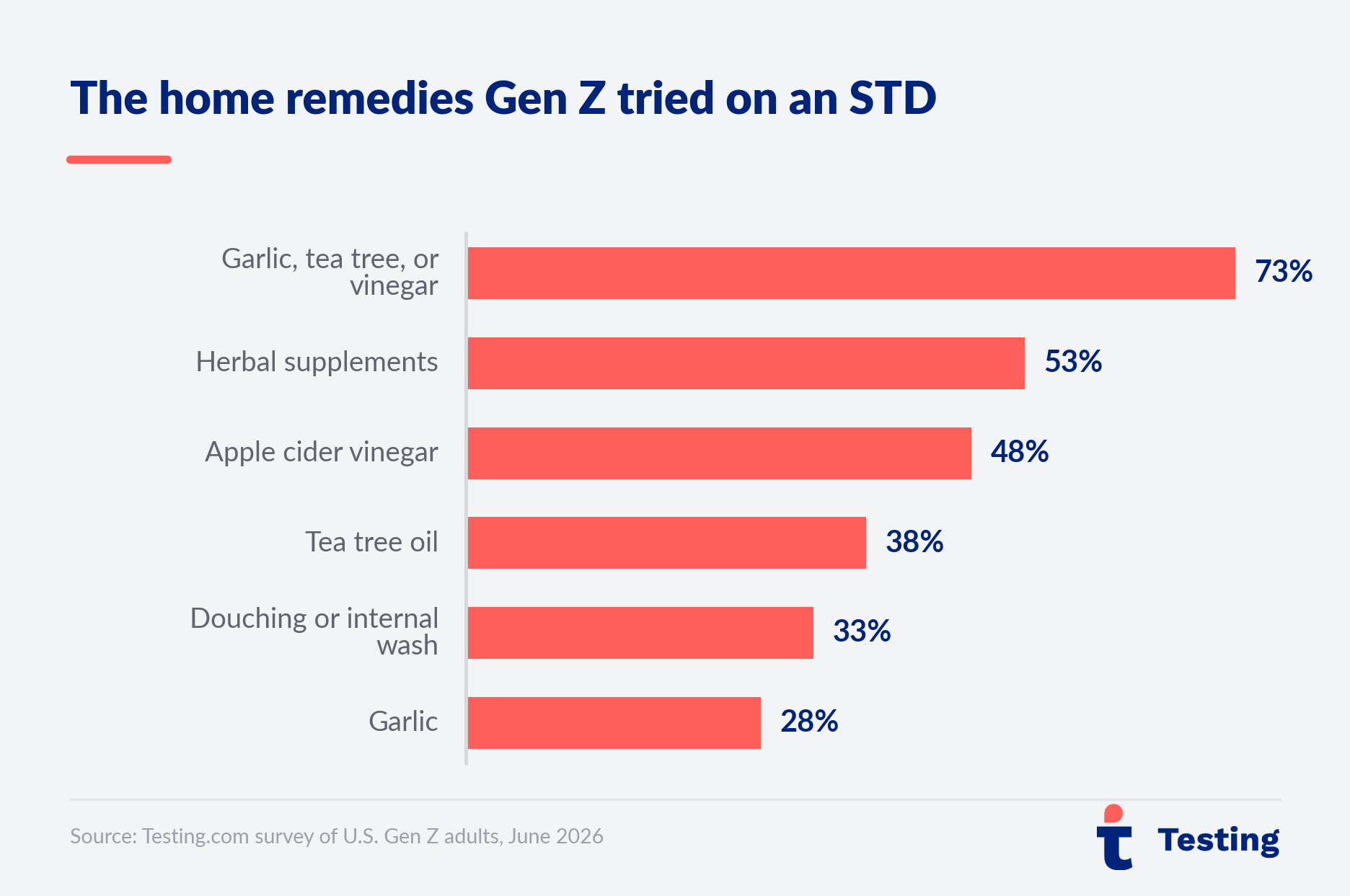
The home remedies Gen Z turned to for a suspected STD came from the kitchen and the supplement aisle. Among self-treaters, 73% used at least one of apple cider vinegar (48%), tea tree oil (38%), or garlic (28%). Herbal or “natural antibiotic” supplements, a separate category, were the single most used remedy at 53%, and 33% used douching or an internal wash.
Most expected the home remedy to work from the start. 61% said they were sure it could cure or improve the STD when they began, including 24% who said it definitely would.
“There is no clinical evidence that these home remedies can cure STDs in humans, and relying on them in place of proven treatments leads to serious risk of complications,” says Toni Brayer, M.D., an internal medicine doctor and member of Testing.com’s medical review board. “We have excellent cures backed by robust clinical trials. The information about home cures from social media sites and content creators is wrong.”
3 in 4 Skipped a Doctor Over Embarrassment or Lack of Insurance
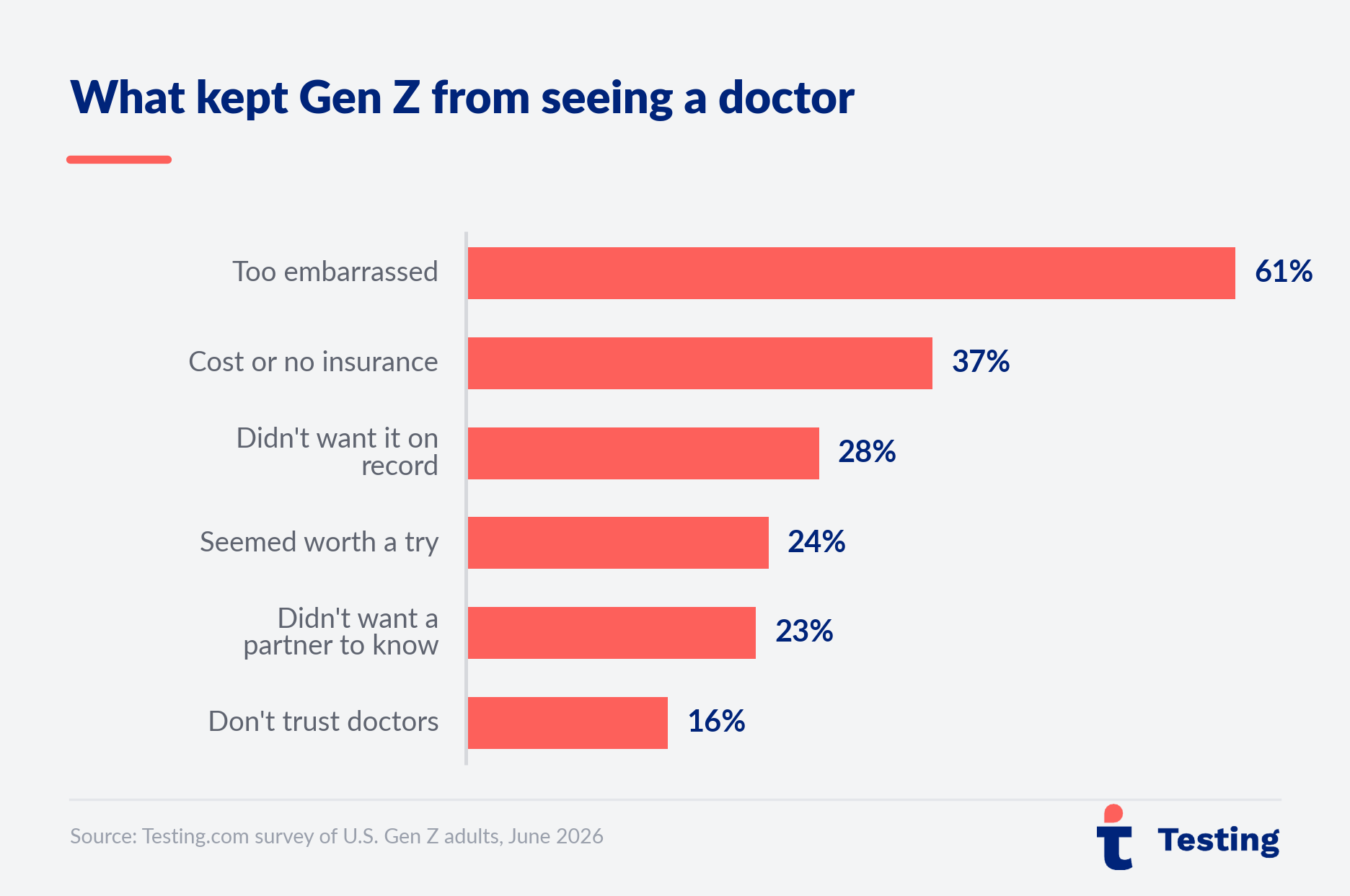
For 77% of self-treaters, skipping a doctor first came down to embarrassment or cost. 61% said they were too embarrassed to see a doctor, and 37% pointed to cost or a lack of insurance. Beyond those, 28% did not want the STD on their medical record and 16% did not trust doctors. Another 24% said the remedy seemed worth a try because they could still see a doctor later.
Many never confirmed what they were treating at all. 56% had suspected an STD but never had it verified by a test or a doctor before reaching for a remedy.
Asked in their own words, respondents returned to the same themes. Many described being “too embarrassed” to sit across from a doctor, and one did not want to be seen as “nasty.” Others were blunt about money, including one who was “financially struggling” with no insurance for a visit. Some were not certain they had an STD at all, like the respondent who “wasn’t sure if it was even an STD” and did not want to pay to find out. A few distrusted the medical system itself, including one who said doctors “lie for a profit.”
“It can be very dangerous to treat an STD without testing first. Symptoms like burning, discharge, sores, or pelvic pain can be caused by many different conditions, not just STIs, and without testing it is impossible to identify what is causing them,” says Dr. Brayer. “Chlamydia, gonorrhea, syphilis, and genital herpes can look alike but be treated incorrectly, and the infection can persist and be passed on to partners. Test first, treat second.”
1 in 3 Believe They Passed the STD to a Partner
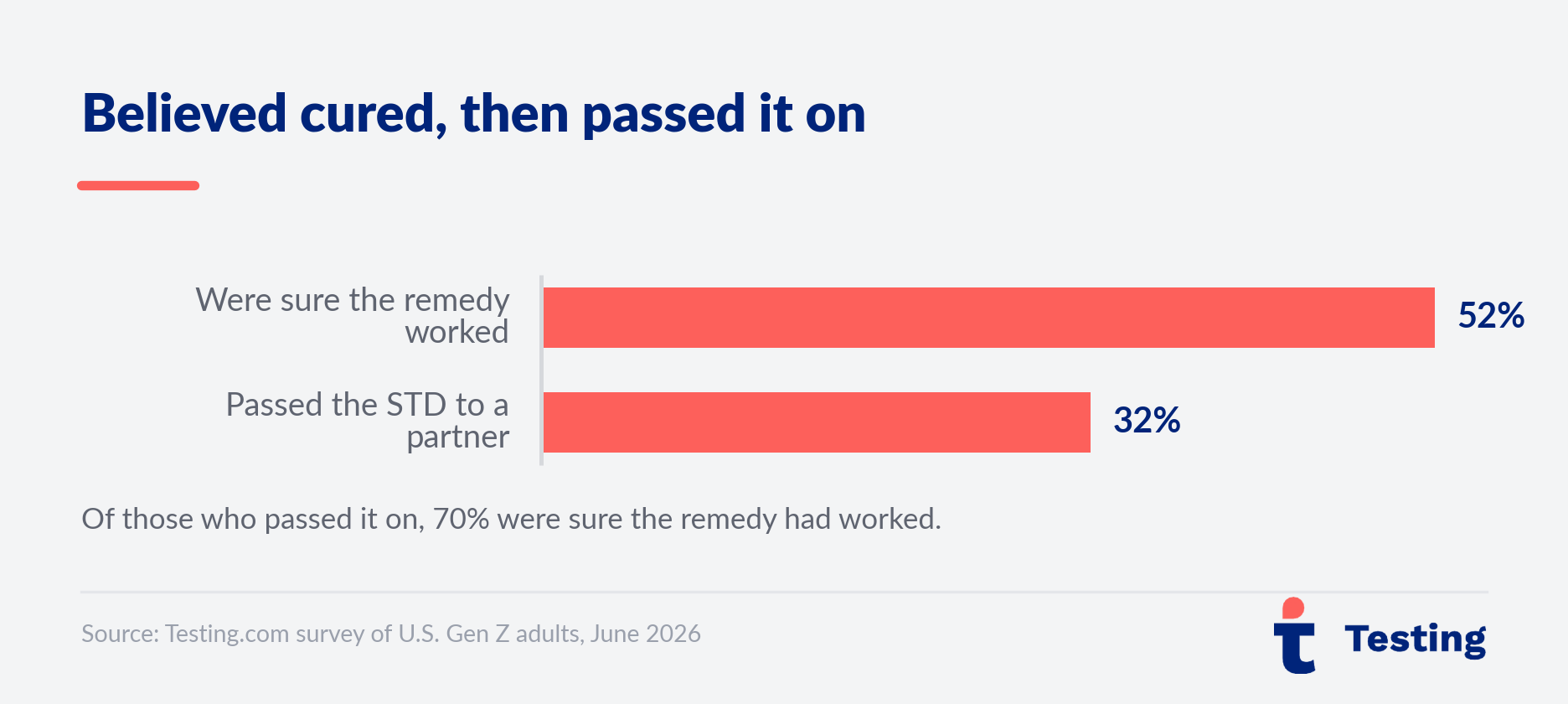
After treating themselves, 52% were convinced the remedy had cleared their infection, a belief that ran highest among those who found it on social media, at 57% versus 34% for those who learned about it elsewhere.
The infection did not stay contained. 23% of self-treaters said one reason they avoided a doctor was not wanting a partner to know, and 32% believe they passed the STD to a partner while treating it themselves. 70% of those were sure the remedy had worked at the time.
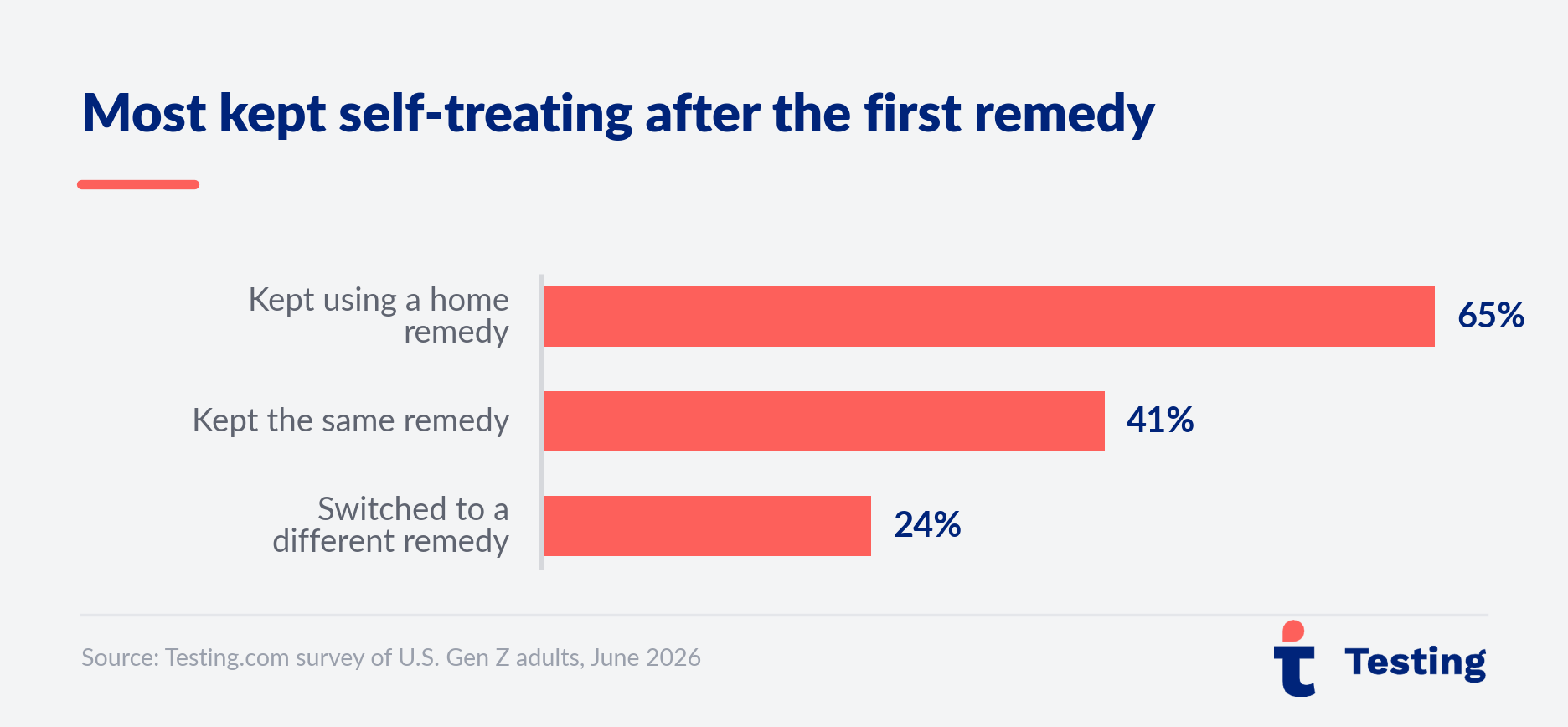
Most Kept Using Home Remedies After the First Try
For most who self-treated, the first remedy was not the last. 65% kept treating the STD at home, 41% with the same remedy and 24% with a different one.
“When symptoms fade it can create a false sense of security. A person may feel cured while the infection continues to damage their health and infect others,” says Dr. Brayer. “Untreated chlamydia and gonorrhea can persist silently and cause pelvic inflammatory disease or ectopic pregnancy, and partners can become infected without realizing it, creating a chain of ongoing transmission. Symptom improvement should never be used as proof that an STI is gone.”
Methodology
In June 2026, Testing.com surveyed 1,000 U.S. Gen Z adults, ages 18 to 29, who reported having had or suspected they had an STD, using the Pollfish survey platform. Pollfish uses Random Device Engagement to reach respondents through in-app surveys rather than opt-in panels, which helps reduce fraud and duplicate responses and broadens sample diversity. Attention checks and other fraud-detection tools were used to identify invalid responses. The margin of error is approximately plus or minus 3 percentage points at a 95% confidence level. Results are based on self-reported responses.